
The challenge
Ayres Dorados sells its 20 rooms through Todo Alojamiento (the booking engine that distributes availability to the different platforms), but the front desk runs the hotel from a Google Sheets grid filled in by hand. When the two didn’t match, bookings ended up without a room, got entered twice or, worst case, there were more guests than rooms. Checking it meant going through spreadsheets one by one.
What I did
A system that does that check on its own and shows it in a dashboard inside the hotel’s website.
- A bot that runs every hour, from 7 am to 11 pm: it pulls bookings from the official Todo Alojamiento API, downloads the grid from Drive and compares them day by day, counting the two apartments the hotel uses as extra capacity.
- Automatic grid updates: anything sold but missing from Drive is written only into free cells, highlighted in green. It never deletes or overwrites anything.
- Leveled alerts: overbookings, bookings with no room, cancellations still on the grid, and name or date mismatches, with a daily summary by email and in the spreadsheet itself.
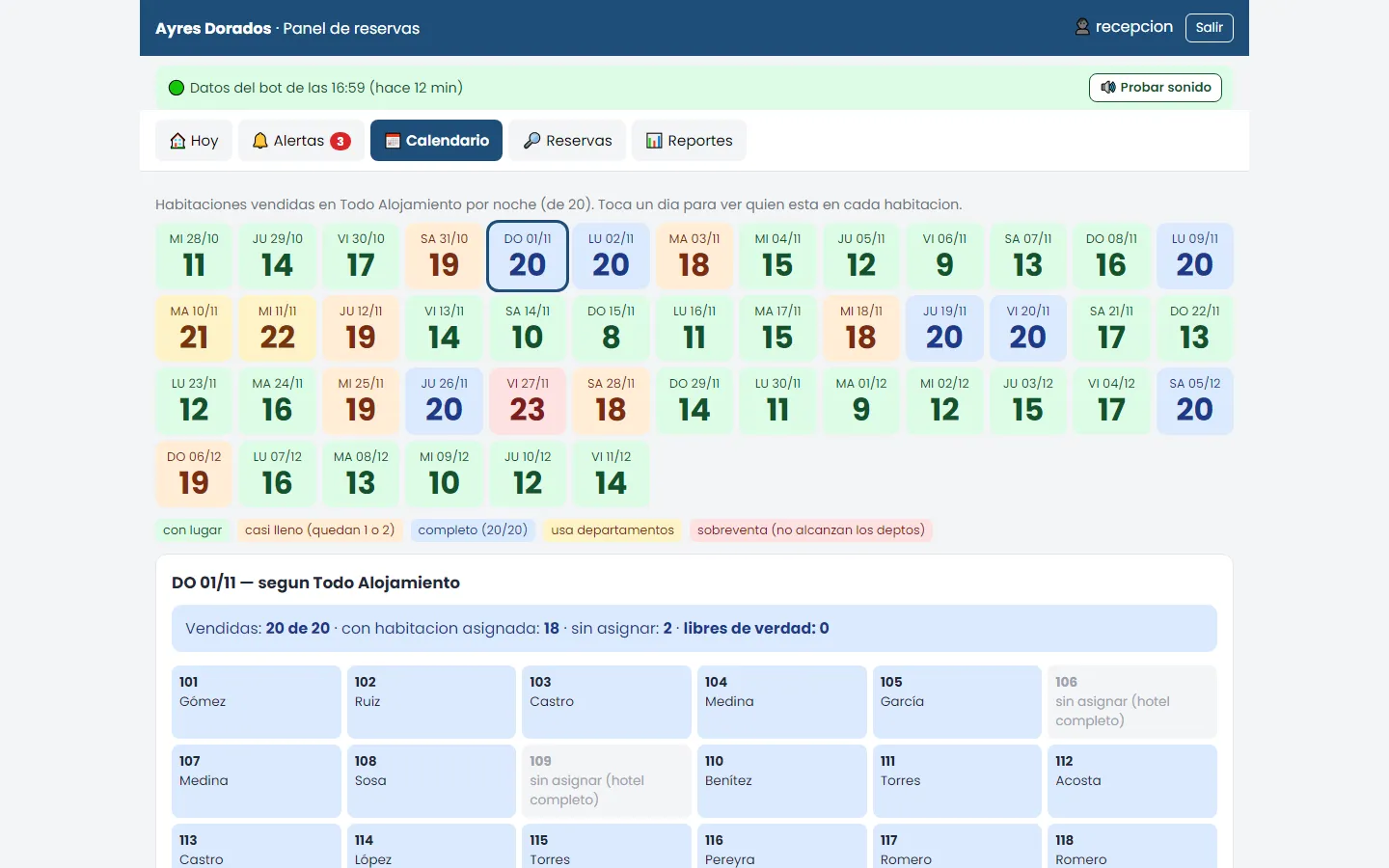
- An /admin dashboard on ayresdorados.com, with login and two roles (front desk and admin):
- Today: tonight’s occupancy, arrivals, departures and the bot’s status.
- Alerts: each one can be marked as reviewed or resolved, and who did it is logged.
- A 45-day calendar color-coded by occupancy; tapping a day shows who is in each room.
- Bookings with search, reports on revenue, average rate and booking source, and a full history for the admin.
- Live notifications: the dashboard checks every minute and, if the bot found something new, plays a sound and shows a browser notification.
Technical decisions
- Read-only on Todo Alojamiento. The bot uses the PMS API (OTA XML) with queries that leave no marks in the system. If the API fails, a Playwright robot downloads the listing from the extranet, pausing like a person would and reusing the session.
- Google Sheets stays the front desk’s tool. The bot writes through the official API with a service account, cell by cell, without changing how the hotel works.
- Simulation mode. Before writing to the real spreadsheet, the bot ran reporting what it would fill in, so the rules could be validated on real data with no risk.
- A small, self-contained backend. FastAPI with SQLite, listening only on
127.0.0.1behind Nginx. HMAC-signed session cookies, a 10-minute lockout after 5 failed attempts, and no public API docs. - The dashboard is a React island inside the Astro site I had already built for the hotel: it adds no weight to the public pages and isn’t indexed.
- Everything runs on the VPS with systemd: a timer for the bot (with a random delay so it never hits the API at the same second), a service for the API, and an optional one for WhatsApp notifications with Node.js.
Result
The front desk sees on one screen what used to require cross-checking two systems, and overbookings are caught within the hour they appear, not on the day the guest arrives. Screenshots use sample data.